
Galavanting with the Ghost in the Machine
Authored by: Jay Archambeau
There are moments when experience quietly reshapes an opinion.
Not because someone wins an argument.
Not because a headline finally convinces you.
And certainly not because technology demands your surrender.
Sometimes you simply spend enough time with something that your understanding deepens.
That has been my experience with artificial intelligence.
If you've followed my writing for any length of time, you know I haven't exactly been AI's biggest cheerleader. Like many creative professionals, I watched it arrive with equal parts curiosity and concern. I wondered what it meant for those of us who had spent careers designing experiences, solving problems, telling stories, and building brands.
Would this become another tool?
Or would it become our replacement?
Those weren't unreasonable questions.
In fact, I still think they're worth asking.
The difference today is that I have the benefit of experience instead of speculation.
Truth be told, I didn't set out to embrace AI.
I simply wanted to rebuild my portfolio.
What I expected would be a few weeks of polishing quickly turned into months of revisiting more than two decades of work. Old case studies. Photography. Accessibility improvements. Responsive layouts. HTML. CSS. JavaScript. SEO. Storytelling. Hundreds upon hundreds of pages and countless tiny decisions.
At some point I realized I had taken on a project that was simply too large for one person to complete efficiently.
So I invited an unlikely collaborator to the table.
That collaborator happened to be artificial intelligence.
Not to do the work for me.
To help me do the work better.
That distinction became more important with every passing week.
As the portfolio began taking shape, something interesting happened. Friends started asking whether AI had designed it.
It was a fair question.
After all, they were watching months of work appear at a pace that would have been difficult for one person to sustain alone.
The answer, however, was no.
Not even close.
It never decided which projects deserved inclusion.
It didn't remember why one client loved a direction while another rejected it.
It didn't know which stories were worth telling, which failures deserved mentioning, or which lessons were more valuable than the finished artwork itself.
Those memories belonged to me.
The judgment belonged to me.
The experience belonged to me.
But once direction had been established...
My goodness.
What an extraordinary production partner.

One example still makes me smile.
Years ago, I designed the identity for the Sterling Company. The logo already existed. The thinking already existed. The strategy already existed.
What didn't exist was the ability to easily demonstrate that identity living throughout an organization.
Together, AI and I explored how the brand could appear on fleet vehicles, uniforms, business collateral, environmental graphics, apparel, and signage. None of those applications changed the design itself.
They changed the presentation.
Suddenly, people could see the identity doing what it had always been intended to do.
The logo hadn't become stronger.
The story had.
Another favorite came from an old Rockwell Electronic Commerce User Conference project.
When I originally completed the work years ago, very little documentation survived. A handful of artifacts. A few scattered graphics. An old and tattered t-shirt. Mostly memories.
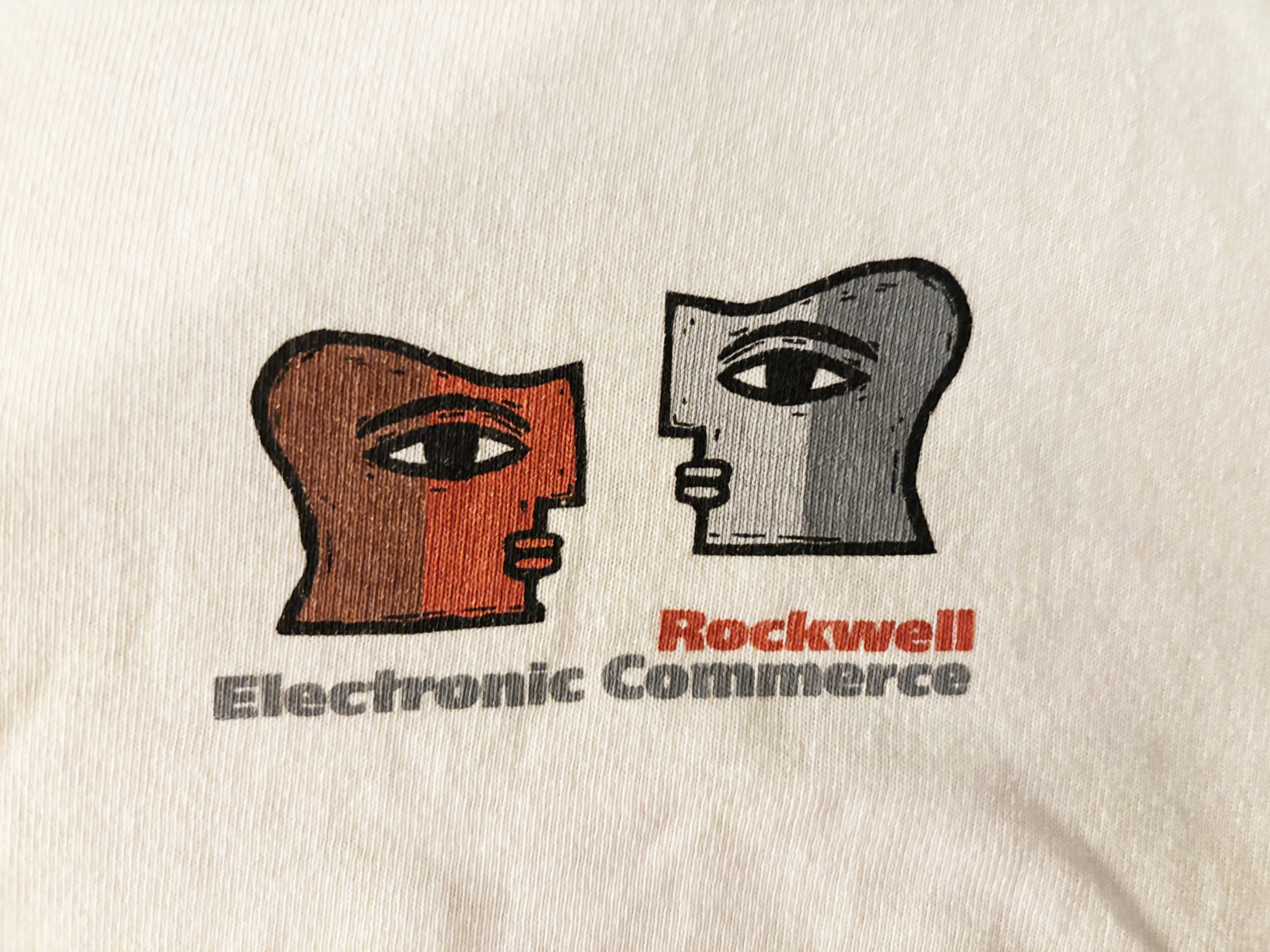
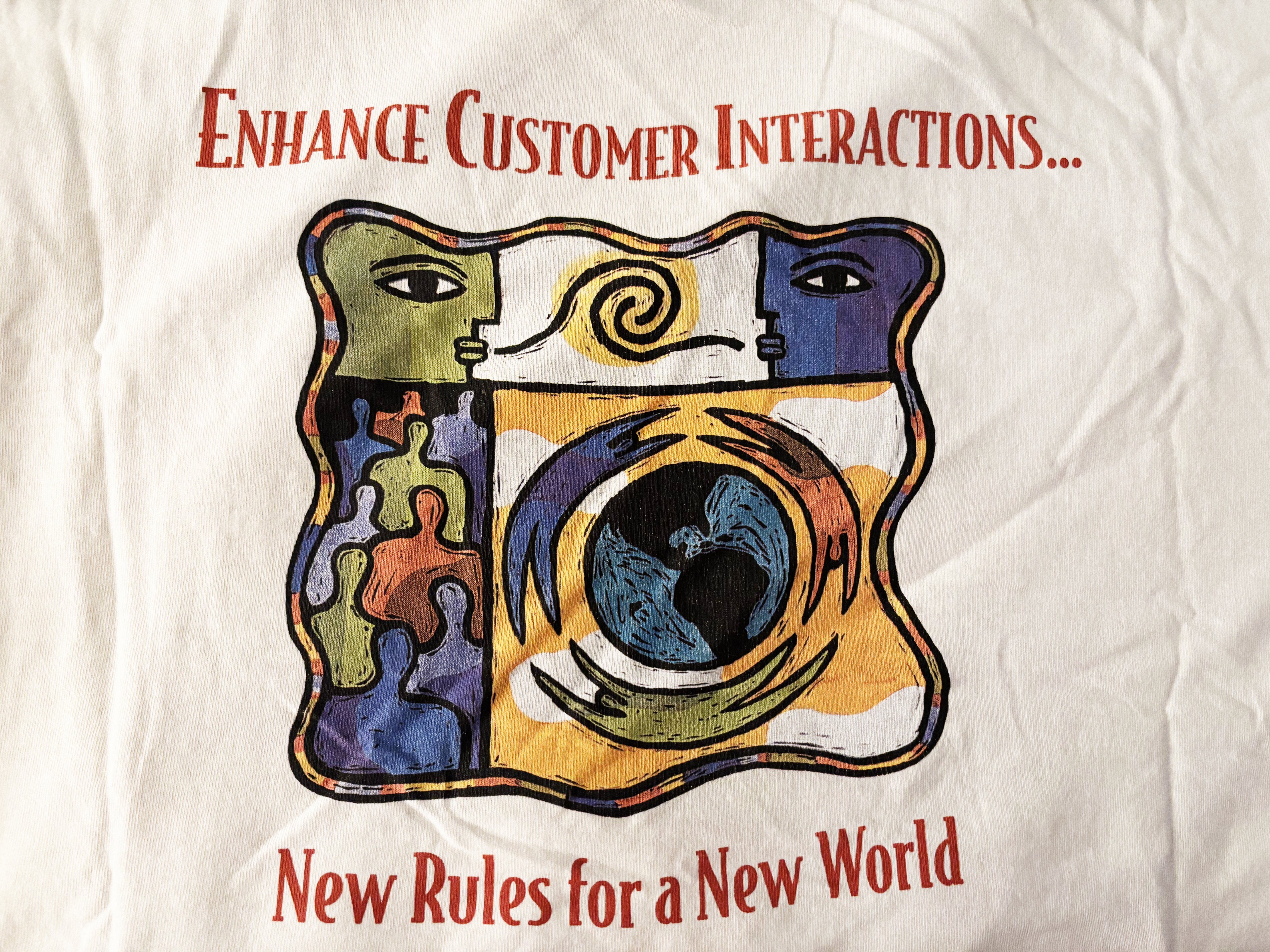
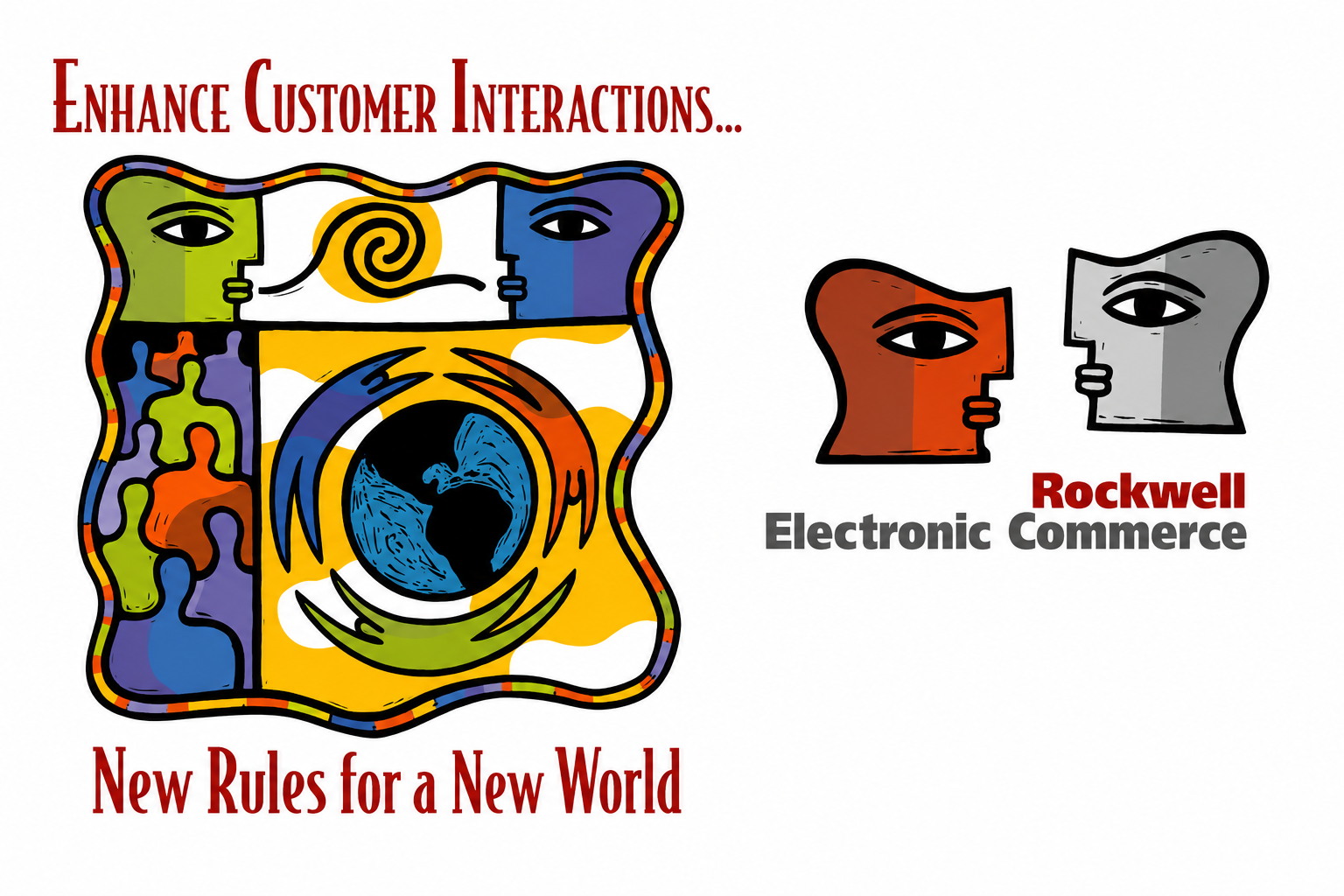
The artifacts, scattered graphics, and an old faded and tattered t-shirt ... But all in all, mostly memories. Together, those elements became reconstructed presentation boards, conference materials, environmental graphics, and even the resurrected conference T-shirt, all communicated the scope of the project far better than I ever had before.
The machine wasn't remembering history.
I was.
The machine simply helped rebuild the stage so the story could finally be told.
Of course, collaboration wasn't always smooth.
Believe me, we've had our share of disagreements.
Just ask the HTML validator.
There were days when AI confidently assured me everything was perfect, only for the validator to politely respond,
“Absolutely not.”
More than once I found myself saying,
“That's brilliant.”
Only minutes later...
“No, that's completely wrong.”
In fairness, I suspect AI was thinking much the same thing about me.
And then there was the infamous shuttle bus.
While reconstructing one of the Rockwell conference displays, AI somehow concluded that shuttle buses apparently don't require wheels.
It was an impressive rendering.
Just... somewhat lacking.
Progress, it seems, still has room for improvement.
One of my favorite moments during the reconstruction. AI confidently produced a beautifully rendered shuttle bus... without wheels. It was a humorous reminder that confidence and correctness are not always the same thing—and that human judgment still matters.
Humor aside, the deeper realization wasn't about AI at all.
It was about design.
Somewhere between rebuilding case studies, cleaning thousands of lines of HTML and CSS, improving accessibility, refining storytelling, and polishing presentation after presentation, I stopped asking whether AI was coming for my profession.
Instead, I found myself asking a different question.
What is it, exactly, that designers are paid to do?
For years I might have answered,
“Design interfaces.”
Or,
“Create graphics.”
Or,
“Build websites.”
Today my answer is much simpler.
We solve problems.
Everything else is merely the medium.
That realization became even clearer because of where I now spend my days.
These days I work in a warehouse.
On paper, that has almost nothing to do with UX design.
Yet every shift I catch myself observing how people interact with their environment.
Where do they hesitate?
What slows them down?
Which tools create unnecessary friction?
Which processes rely too heavily on memory instead of good systems?
How could this task become safer?
Simpler?
Faster?
Less mentally exhausting?
Those aren't warehouse questions.
Those are user experience questions.
The medium has changed.
The mindset hasn't.
During one of my final design assignments, my friend and coworker Jonny sent me an email after we had been discussing my future.
One sentence has stayed with me ever since.
“Jay, design will not leave you. You'll find yourself thinking of design solutions and problem identification—problem solving—no matter what you're doing.”
At the time, I appreciated the encouragement.
Today, I appreciate the accuracy.
Jonny wasn't really talking about software.
He was talking about the way designers see the world.
And it turns out...
He was absolutely right.
Ironically, working alongside AI helped me understand that.
I spent a long time wondering whether artificial intelligence would replace designers.
Months later, I realized I had been asking the wrong question.
The better question wasn't whether AI could design.
It was whether I was willing to learn how to design with it.
Those are two very different conversations.
None of this means my earlier concerns have disappeared.
The industry is changing.
Budgets are changing.
Expectations are changing.
Some creative jobs will undoubtedly disappear.
Others will evolve into something we barely recognize.
Ignoring that reality would be foolish.
But so would pretending AI can replace curiosity.
Or empathy.
Or judgment.
Or lived experience.
Or the quiet instinct that tells you something doesn't feel right long before you can explain why.
Artificial intelligence didn't make me a better designer.
It made me a faster editor.
A more efficient developer.
A stronger storyteller.
A more productive collaborator.
But perhaps most importantly...
It made me a better student.
Because learning requires humility.
And humility occasionally asks us to admit that experience has taught us something we couldn't have learned from a distance.
So yes...
I've been galavanting with the ghost in the machine.
We've argued.
We've laughed.
We've rebuilt years of work together.
It's amazed me.
It's frustrated me.
And every so often, it's confidently assured me that a shuttle bus doesn't really need wheels.
Thankfully, one of us still knew better.
Because that's the thing I've come to understand.
The ghost may be remarkably clever.
But it still needs someone to know where the road goes.
Turns out, the ghost didn't teach me how to design.
It simply reminded me that I never stopped.