
UX/UI Design Study
CCH Tax & Accounting Redesign
Simplifying complex professional research through clearer information architecture, enterprise search, product discovery, and current-awareness workflows for accounting, tax, and finance professionals.

Project Tags
Executive Summary
CCH, a Wolters Kluwer business, served professionals who depended on accurate, timely, and highly specialized information. The redesign focused on making a broad catalog of tax, accounting, legal, training, community, and research resources easier to navigate, evaluate, and act on.
The work was less about simplifying the content itself and more about simplifying the experience around it. Accounting professionals still needed depth, precision, citations, product detail, legislation updates, and professional tools. The interface needed to make that complexity scannable, searchable, and trustworthy.
This study highlights four representative redesign views: the enterprise portal, product-category experience, search results, and tax legislation updates. Together, they show a system built around professional discovery, current awareness, and decision support.
The Challenge
Tax and accounting professionals work in a high-stakes information environment. They need to move quickly through publications, legislation, updates, expert analysis, product options, and continuing education without losing confidence in the accuracy or completeness of what they find.
The redesign challenge was to create an experience that could support broad exploration and precise retrieval at the same time. New visitors needed a clear entry point into markets and solutions, while expert users needed fast access to search results, product details, legislation updates, and reference material.
Enterprise users do not need less information. They need better organization, clearer pathways, and interfaces that help them trust what they are seeing.
Information Architecture
Organizing Professional Products and Publications
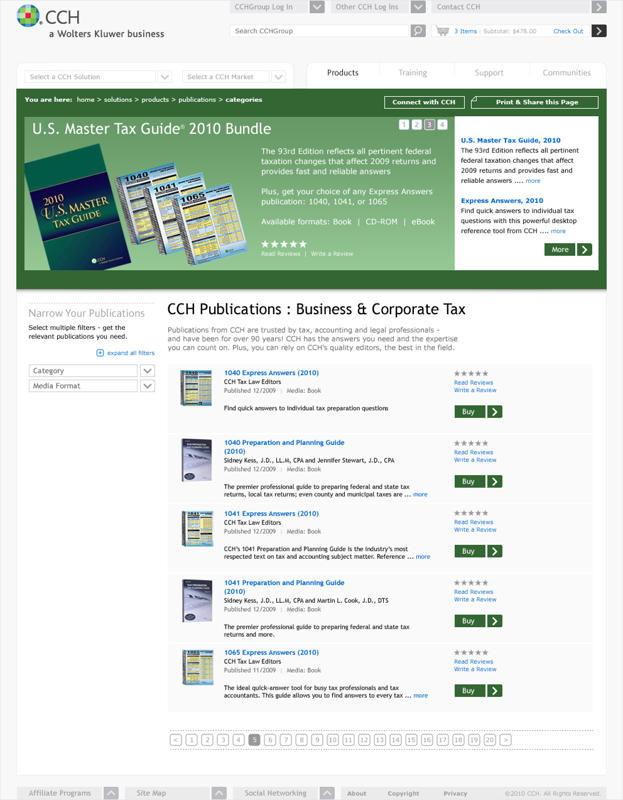
The product-category experience brought structure to a dense catalog of publications, bundles, formats, and professional resources. Filters, metadata, ratings, pagination, and purchasing actions created a repeatable pattern for evaluating specialized products.
Reduce Cognitive Load
Dense information was grouped into predictable regions so users could scan before committing attention.
Respect Expert Users
The design preserved precision, detail, and professional terminology instead of oversimplifying the domain.
Support Exploration
Navigation, filters, and related content helped users move from broad categories to specific products or research items.
Build Trust
Clear hierarchy, source cues, metadata, and restrained visual design reinforced confidence in the content.
Search & Discovery
Helping Professionals Find the Right Resource
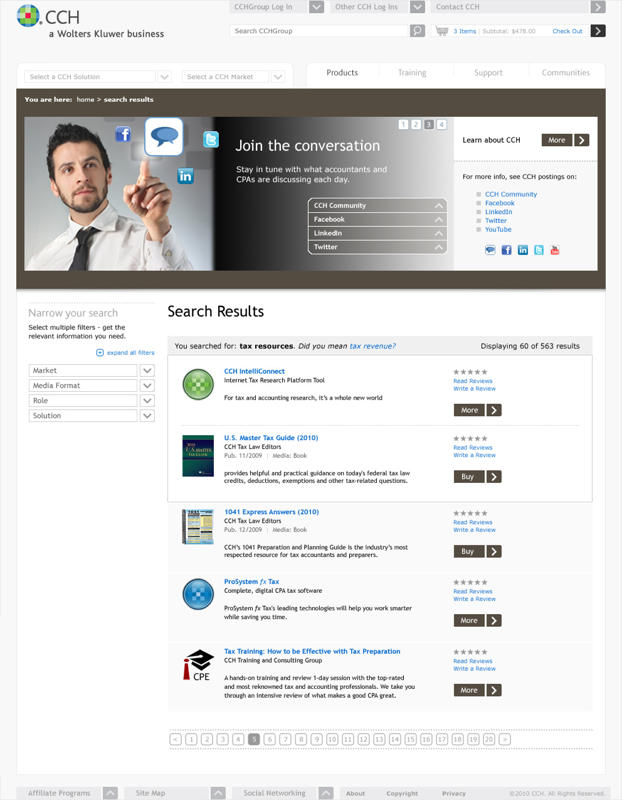
The search results experience combined keyword search, spelling assistance, result counts, faceted refinement, mixed result types, ratings, summaries, and purchase or learn-more actions. The goal was to make a large professional library feel navigable without hiding its depth.
Living Knowledge
Keeping Tax Professionals Current
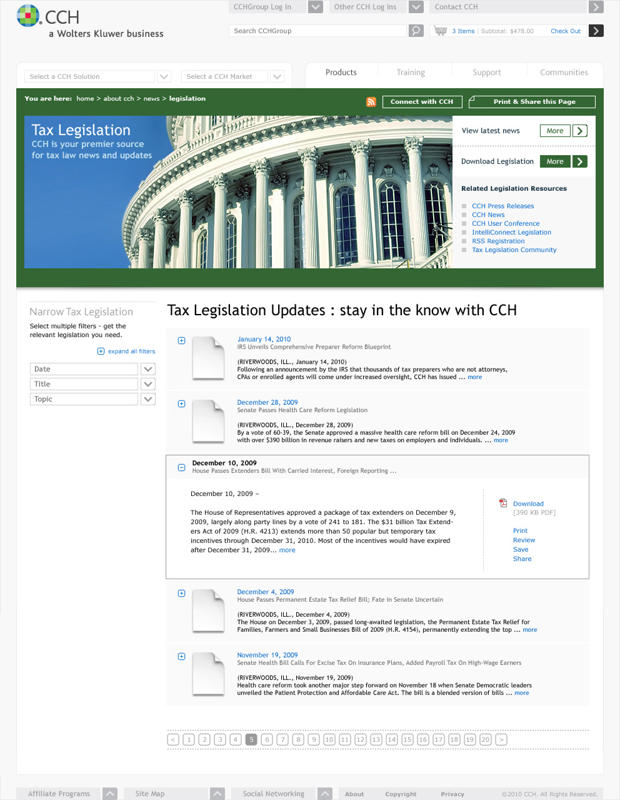
The tax legislation experience reframed the platform as more than a static product catalog. It became a living knowledge environment where users could follow updates, expand summaries, download legislation, print, review, save, and share content.
Enterprise Portal
Connecting Markets, Solutions, Products, and Communities
The homepage served as an orientation layer for a broad professional ecosystem. Users could enter through solutions, markets, products, training, support, communities, topical content, account utilities, or commerce pathways.
Design Decisions That Mattered
- Navigation by intent: The experience supported multiple entry points because professional users arrived with different levels of certainty.
- Faceted refinement: Filters helped users reduce large result sets without forcing them into a rigid path.
- Metadata-first hierarchy: Publication date, media format, category, rating, and summary content helped users evaluate resources quickly.
- Current-awareness workflows: Tax legislation content emphasized timeliness, related resources, and actions like download, print, save, and share.
- Commercial actions in context: Buy and more-information actions were present but visually secondary to research and evaluation.
Reflection
Looking back, the enduring challenge is not that tax and accounting information is complex. It has to be. The design opportunity is to make complexity feel organized, trustworthy, and actionable for professionals who are under time pressure and making high-consequence decisions.
If I were redesigning this experience today, I would explore AI-assisted research, semantic search, conversational querying, citation intelligence, personalized dashboards, saved research trails, and proactive alerts tied to a user's market, role, and areas of practice.
The tools have changed dramatically, but the underlying UX challenge remains the same: help professionals find trustworthy information quickly and understand what to do next.
Continue Exploring
Related Design Studies
CCH sits alongside other enterprise UX studies focused on discovery, information architecture, and complex product ecosystems.