
Digital Brand Standards Case Study
Quill Brand Guidelines
A self-initiated digital brand standards effort created to bring consistency, measurement, and shared visual direction to Quill.com during a period of rapid eCommerce growth.
Project Highlights
Overview
As Quill.com grew rapidly during the early 2000s, the digital design team was producing more web graphics, email campaigns, banners, landing pages, and promotional modules than ever before.
The business was moving quickly, web commerce was expanding, and multiple designers were producing digital assets under compressed timelines.
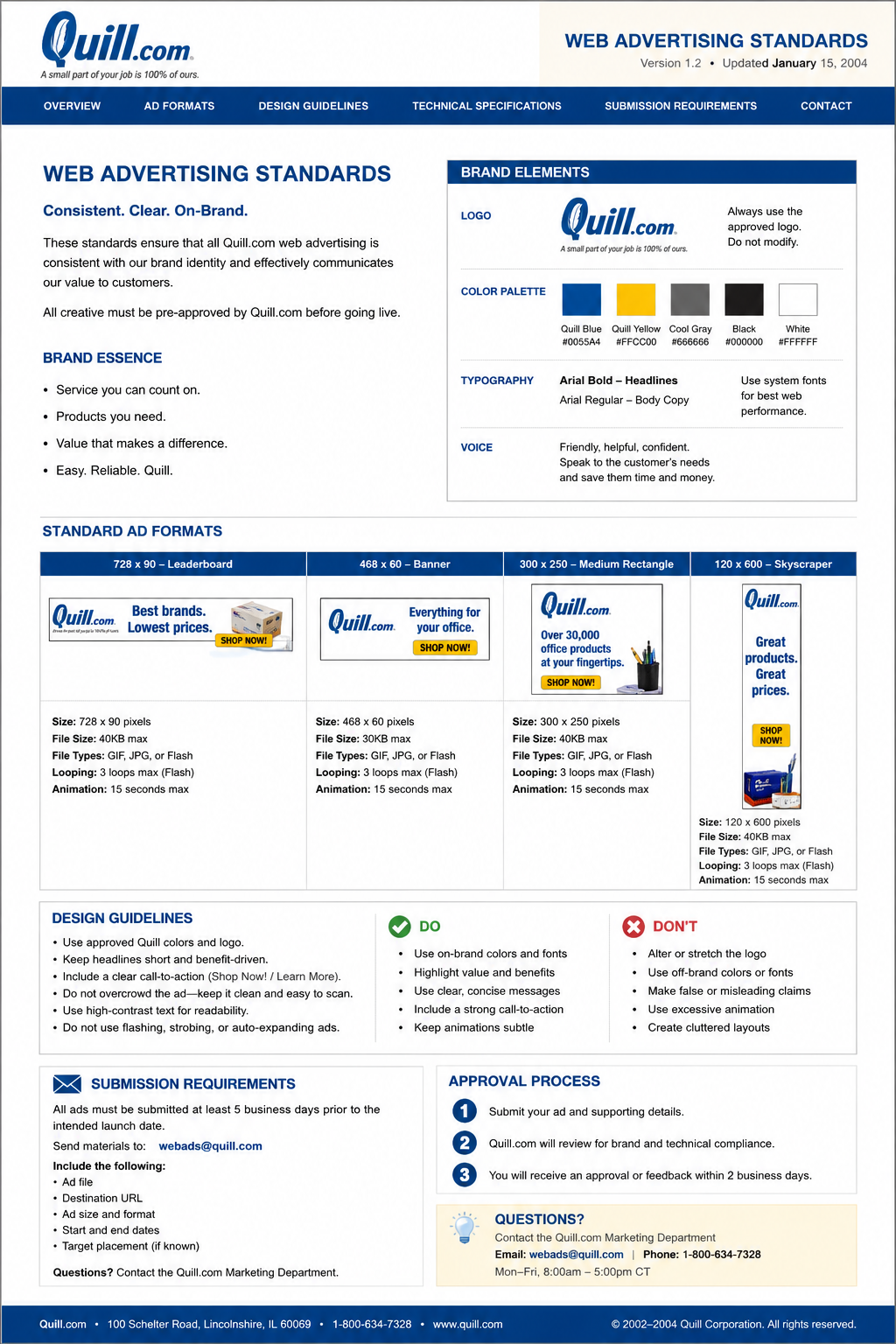
I recognized that the team needed a shared reference for how Quill’s digital brand should be represented online, so I created and published a web-focused brand guidelines document on my own initiative.
Challenge & Opportunity
The challenge was consistency.
Designers were using separate settings, different measurements, and varying graphic treatments. As a result, digital graphics did not always appear consistent in style, scale, spacing, or presentation.
At the time, no formal style guide or branding guide had been developed specifically for Quill’s web work. The opportunity was to create a practical reference that could help the team make more consistent decisions as the eCommerce portion of the business grew rapidly.
Why It Was Needed
Quill’s digital environment included banners, email modules, landing pages, promotional graphics, campaign imagery, and other web-based assets.
Without shared standards, even small variations could make the experience feel fragmented. Differences in image dimensions, placement, type usage, color, tone, photography, and spacing could quickly add up across a large eCommerce site.
The guidelines were created to reduce guesswork and give designers a common starting point.
My Contribution
As Interactive Designer, I created the digital brand guidelines independently and published the documentation on my own volition.
The guide included standards for:
- Logo usage
- Typography
- Color usage
- Web banners
- Email modules
- Photography treatment
- Promotional tone
- Pixel dimensions
- Placement rules
- Measurements and spacing
- Digital graphic standards
Digital Measurement Standards
One of the most practical parts of the work involved documenting dimensions, placements, and measurements for recurring web assets.
In a fast-moving eCommerce environment, consistent pixel dimensions and placement rules helped designers create assets more efficiently and helped reduce visual inconsistency across campaigns.
These standards also helped support smoother handoff and implementation because teams could work from shared expectations rather than individual preference.
Self-Initiated Systems Thinking
This work was not assigned.
I saw the need, created the documentation, and published it because the team needed a stronger foundation for digital consistency.
Looking back, this was another early example of systems thinking in my career: noticing repeated problems, identifying patterns, and creating a shared resource that helped other people work more effectively.
Outcome
The documentation was well received by designers and upper management.
It helped improve consistency across web graphics, email modules, banners, and digital promotional materials during a period when Quill’s web commerce business was growing by leaps and bounds.
The effort also helped establish a clearer design foundation for future digital marketing work and supported a more professional, unified Quill.com experience.
Reflection
Quill’s brand guidelines reinforced a principle that has followed me throughout my career:
If a team keeps solving the same problem differently, it may not need another meeting. It may need a standard.
This project helped me understand that brand consistency is not only about taste or preference. It is about creating clear rules, shared references, and practical documentation that allows a growing team to move quickly without losing cohesion.
Interested in working together?
Whether you’re building a design system, refining brand standards, or creating a stronger digital marketing foundation, I’d love to hear about it.
Get in Touch